

Hydronic piping
Pipe the UNI 60 — 2 in supply and return, mandatory safety relief valve, expansion tank, drain and return-temperature protection to stop condensation corrosion.
Pipe the boiler with 2 in supply and return, a safety relief valve that can never be isolated, an expansion tank, a drain, and return-temperature protection. The relief valve and the return protection are the two items installers most often defer — and the two that cause the most expensive failures.
Relief valve is mandatory
Never use the appliance without a relief valve. Position the discharge drainage so that it is safe in case of opening — it discharges boiling water under pressure.
Connection schedule
| Connection | Size | Notes |
|---|---|---|
| Supply (flow) | 2 in | Callout 11 on the structure drawing |
| Return | 2 in | Callout 12 |
| Drain | — | Callout 13, at the base |
| Flue outlet | 8 in | Callout 4 |
| Sensor well | — | Callout 14, top of the boiler |
Required devices
Safety relief valve
Fit it on the boiler side of any isolating valve, so it can never be valved out. Run the discharge to a safe location.
Maximum operating pressure is 15 psi; maximum test pressure is 50 psi; pressure must never be allowed above 36 psi.
Expansion tank
An open or membrane expansion tank is required on both closed and open systems. Size it from the heating volume as part of the system design.
Return-temperature protection
Fit a thermostatic valve that holds the return above roughly 130 °F.
A boiler protection valve is mandatory if the system operates below 140 °F.
If you use direct circulation without a thermostatic valve and the return falls below 122 °F, the supply must be set to at least 149 °F to avoid condensation.
Check valve on make-up
If using automatic make-up water, install a check valve according to local regulations. Fill at a pressure not exceeding the maximum working boiler pressure.
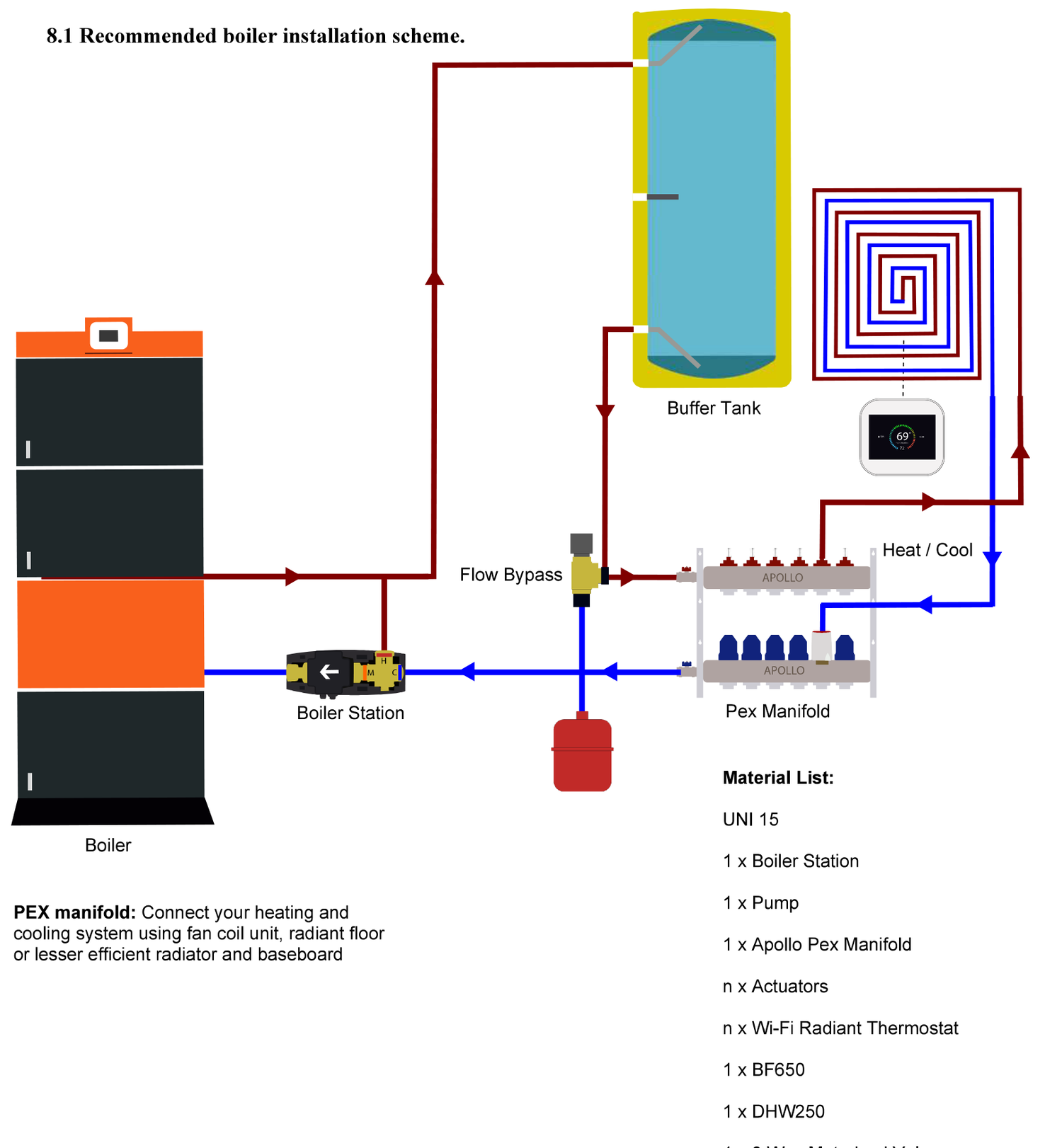
Flow bypass
Include a bypass so the pumps always have a path, even when every zone actuator is closed. The controller forces all pumps on above the boiler cooling temperature.
Why return protection matters
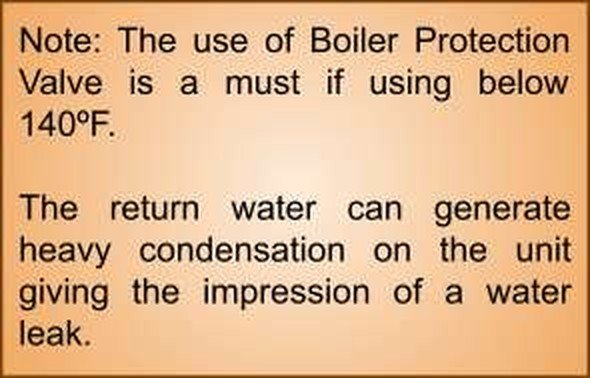
Cold return water condenses acidic moisture and tar onto the inside of the firebox and heat exchanger. That does three things, all bad:
- It corrodes the steel body from the inside.
- It glues soot and tar to the heat transfer surfaces, cutting efficiency.
- It pushes more tar into the chimney, increasing sweeping frequency and fire risk.
MBtek sells an all-in-one boiler station — pump, thermostatic valve and thermometer in one insulated assembly — and a standalone thermostatic boiler protection valve for this purpose.
Natural circulation layouts
If the system circulates by gravity, place the return water pipe below the radiator. Without that height difference the system will not move water.
Pipe for maintenance
- Fit isolating valves so the boiler can be drained without emptying the building.
- Leave the sensor well accessible — the boiler sensor and STB both live there.
- Keep the front 36 in and one side 16 in clear of pipework so the boiler can be brushed out.
Water hardness limits, venting, and the pressure test.
Positioning the boiler
Unpack, move and set the UNI 60 in place — floor, levelling, clearances and the flue connection, before any pipework or wiring begins.
Filling and water quality
Fill the UNI 60 with water below 2 ppm hardness, vent the system, and pressure-test to no more than 50 psi. Scale damage is not covered by warranty.